Data Center Interconnect Design With 200G To 1.6T DAC Cables
Direct attach copper cables designed for 200G, 400G, 800G, and 1.6T Ethernet links provide short range interconnect solutions for modern data center environments. Using high density interfaces such as QSFP DD and OSFP, these assemblies enable efficient connectivity between switches, servers, and accelerators. They are widely used where low latency, controlled power consumption, and consistent electrical performance are required in high bandwidth network infrastructures.
Lane Architecture and Bandwidth Scaling
High speed DAC cables achieve required throughput by combining multiple electrical lanes within a single interface. A 400G connection may operate using eight 50 Gb/s lanes or four 100 Gb/s lanes depending on implementation. As data rates increase to 800G and 1.6T, lane speeds scale accordingly, often requiring PAM4 signaling to maintain bandwidth efficiency.
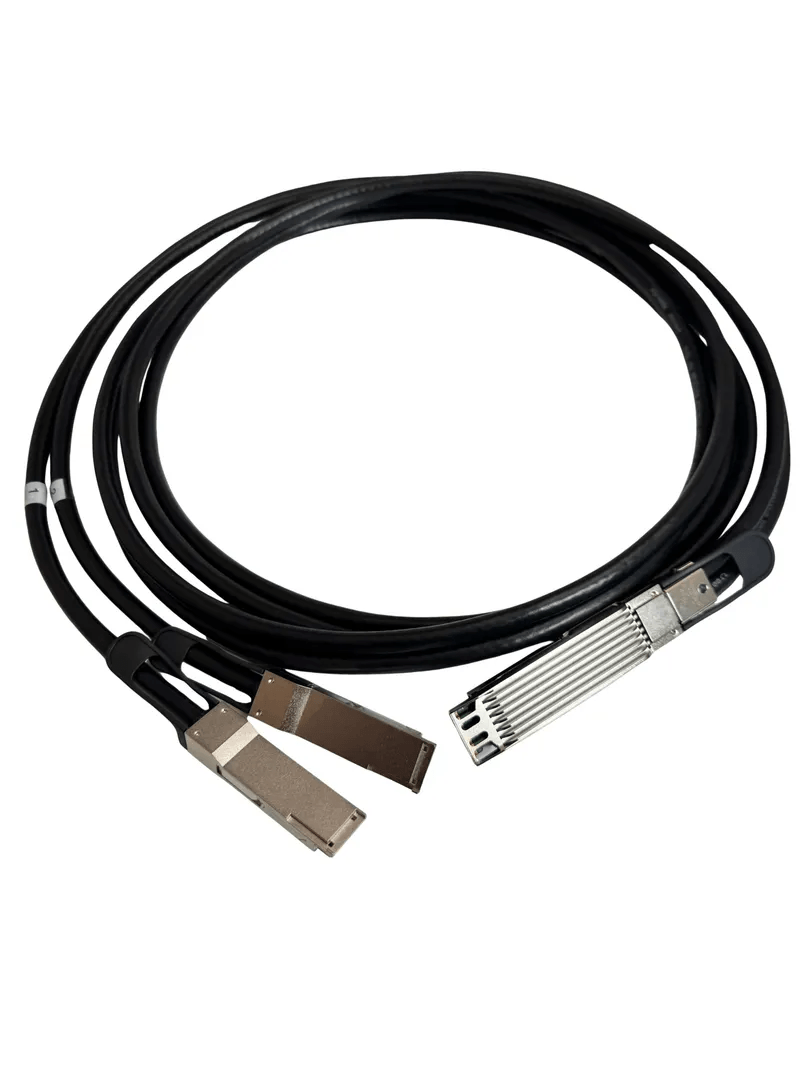
Breakout configurations allow one high speed port to be divided into several lower speed links, enabling flexible connectivity to multiple endpoints. Aggregation operates in reverse by combining several lower speed channels into a single high capacity uplink. These configurations are essential in leaf spine and top of rack network architectures where scalability and port efficiency are critical.
Signal Integrity and Electrical Performance
At elevated data rates, copper transmission introduces challenges related to signal loss and interference. DAC cable design must address attenuation, crosstalk, and impedance variation to maintain reliable communication.
Critical electrical considerations include:
- Insertion loss across the transmission path
- Crosstalk between adjacent differential pairs
- Return loss at connector interfaces
- Equalization requirements within switch and NIC hardware
For 800G and higher speeds, signal conditioning within system components becomes increasingly important. Due to these limitations, DAC cables are typically restricted to short reach connections within or between adjacent racks.
Connector Interfaces and Form Factors
QSFP DD and OSFP are the dominant connector formats for high speed Ethernet up to 800G, with newer interfaces being introduced for 1.6T systems. These connectors support high pin density and are designed to handle increased thermal and electrical demands.
Design considerations include:
- Maximizing front panel port density
- Managing thermal output from high speed interfaces
- Ensuring reliable mechanical retention
- Supporting compatibility with existing infrastructure
Transition strategies often involve breakout cables or adapters, allowing gradual upgrades without full system replacement.
Data Center Deployment Scenarios
DAC cables are commonly deployed in short distance interconnect applications where optical solutions are unnecessary. Their low latency and reduced power requirements make them suitable for dense networking environments.
Typical use cases include:
- Switch to switch connections in leaf spine topologies
- Server to top of rack switch links
- Accelerator and GPU cluster interconnects
- High bandwidth storage networking
Breakout DAC cables improve port utilization by enabling multiple lower speed connections from a single high speed interface.
Installation and Cable Management Considerations
Proper installation and routing are essential for maintaining both performance and serviceability. Cable layout impacts airflow, accessibility, and long term reliability.
Recommended practices include:
- Selecting cable lengths appropriate to rack layout
- Avoiding tight bends that may affect signal quality
- Routing cables to minimize airflow obstruction
- Labeling connections for easier identification
- Verifying compatibility between ports and cable configurations
These measures help maintain stable operation in high density environments.
FAQ (Frequently Asked Questions)
1. What is the typical reach of DAC cables at 800G and 1.6T?
These cables are designed for short range use, generally limited to a few meters due to signal integrity constraints.
2. Can DAC cables support both breakout and aggregation configurations?
Yes, provided the network hardware supports the required lane mapping and configuration modes.
3. Why is PAM4 signaling used in high speed DAC cables?
PAM4 increases the amount of data transmitted per lane, enabling higher overall bandwidth without increasing the number of physical lanes.
4. Are QSFP DD and OSFP connectors interchangeable?
No. They use different mechanical and electrical designs, though some systems may support adapters for interoperability.