High Density Fiber Deployment with MTP to 4x LC OM3 Fanout Cables
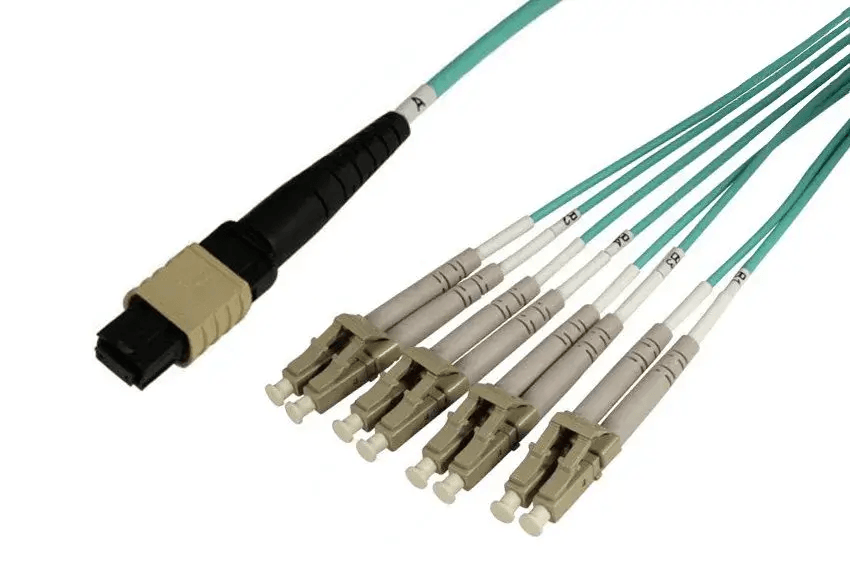
MTP to 4x LC OM3 fanout cables are used to distribute multi-fiber trunk connections into individual duplex fiber links for 10Gb Ethernet applications. These assemblies connect high density MTP interfaces to LC terminated equipment, enabling efficient fiber utilization in data centers. They are commonly deployed in structured cabling systems where space optimization, scalability, and organized fiber management are required.
MTP and LC Interface Architecture
MTP connectors are designed to carry multiple optical fibers within a single interface, supporting high density backbone cabling. In a typical fanout configuration, a 12 fiber MTP connector is divided into four duplex LC connectors, each supporting an independent transmit and receive path.
LC connectors provide standard duplex connectivity for 10Gb Ethernet devices such as switches, servers, and transceivers. The fanout cable enables seamless transition between high density trunk cabling and individual device connections without additional patching hardware.
OM3 Multimode Fiber Performance
OM3 multimode fiber is optimized for laser based transmission and supports 10Gb Ethernet over extended distances within data center environments. It provides sufficient bandwidth for short to medium range links while maintaining compatibility with standard optical transceivers.
Using OM3 fiber in MTP to LC fanout assemblies ensures consistent optical performance and supports high density deployments where multiple 10Gb links are required from a single trunk connection.
Signal Integrity and Optical Loss Considerations
Maintaining optical performance across fanout assemblies requires careful control of insertion loss and connector alignment. Each transition point, including the MTP interface and LC terminations, contributes to overall link loss.
Key considerations include:
- Low insertion loss at MTP and LC connectors
- Proper fiber polarity to maintain transmit and receive paths
- High quality polishing and alignment of fiber end faces
- Cleanliness of connector interfaces to prevent signal degradation
Ensuring these factors helps maintain stable optical links and consistent network performance.
Advantages in High Density Fiber Environments
MTP to LC fanout cables enable efficient use of fiber infrastructure by reducing the number of individual cables required between distribution panels and equipment.
Benefits include:
- Reduced cable congestion in racks and pathways
- Simplified cable management and routing
- Scalable infrastructure for future expansion
- Faster deployment compared to individual fiber runs
These advantages make fanout cables suitable for high density environments where space and organization are critical.
Deployment Scenarios
MTP to 4x LC OM3 fanout cables are commonly used in:
- Data center structured cabling systems
- Switch to server fiber connections
- High density patch panel environments
- Aggregation layers in enterprise networks
- Testing and validation setups for optical links
These deployments support efficient distribution of multiple 10Gb links from centralized fiber trunks.
Installation and Handling Best Practices
Proper handling of fiber cables is essential to maintain performance. Avoid tight bends that exceed the recommended bend radius, as this can introduce signal loss.
Ensure connectors are clean before installation to prevent contamination related attenuation. Maintain correct polarity throughout the installation to ensure proper transmit and receive alignment. Organized cable routing improves airflow and simplifies maintenance.
FAQ (Frequently Asked Questions)
What is the purpose of an MTP to LC fanout cable?
It converts a multi-fiber MTP connection into multiple duplex LC connections for individual devices.
How many LC connections are provided by a 12 fiber MTP cable?
A 12 fiber MTP connector typically supports four duplex LC connections.
Is OM3 fiber suitable for 10Gb Ethernet?
Yes, OM3 multimode fiber is designed to support 10Gb Ethernet over common data center distances.
Why is polarity important in fiber fanout cables?
Correct polarity ensures that transmit and receive signals are properly aligned between connected devices.