Signal Integrity in 800G QSFP-DD Copper DAC Cable Assemblies
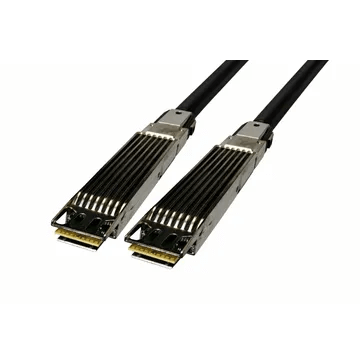
800G QSFP-DD copper direct attach cables are engineered to support ultra high speed data transmission across short reach interconnects in modern data center environments. These assemblies use twinax copper conductors and QSFP-DD connectors to deliver 800 gigabit aggregate bandwidth. Maintaining signal integrity at these data rates is essential for stable link operation, especially in AI clusters and hyperscale infrastructure where performance consistency is critical.
800G QSFP-DD Electrical Architecture
QSFP-DD interfaces support eight high speed differential lanes in each direction, enabling high aggregate throughput within a compact form factor. Each lane operates at advanced signaling rates, placing strict requirements on cable construction and channel performance.
The DAC assembly forms a continuous electrical path between host ports, eliminating variability introduced by separate transceivers. This integrated design helps maintain consistent impedance and predictable channel characteristics across the connection.
Key Signal Integrity Challenges at 800G
At 800G speeds, signal degradation mechanisms become more pronounced due to higher frequencies and tighter tolerances. Even minor discontinuities can affect link stability.
Critical challenges include:
-
Insertion loss across extended frequency ranges
-
Return loss caused by impedance mismatches
-
Crosstalk between closely spaced differential pairs
-
Skew between lanes affecting timing alignment
Managing these factors is essential to ensure accurate data recovery at the receiver.
Cable Design Techniques for Performance Stability
800G QSFP-DD DAC cables incorporate advanced design techniques to address signal integrity challenges.
These include:
-
Precision controlled impedance across all differential pairs
-
Optimized conductor geometry to reduce attenuation
-
High performance shielding to limit electromagnetic interference
-
Tight pair matching to control skew and timing variation
Connector transitions are carefully engineered to maintain signal continuity between cable and port interfaces.
Passive Channel Limitations and Reach Constraints
Passive copper DAC assemblies rely on host side equalization and signal processing to compensate for channel loss. As data rates increase, the allowable channel length decreases due to attenuation and noise.
For 800G applications, DAC cables are typically limited to very short distances, such as within a rack or between adjacent equipment. Beyond these distances, optical solutions are generally required to maintain signal integrity.
Impact of System Environment on Signal Quality
Environmental factors within high density systems can influence cable performance. Thermal conditions, airflow restrictions, and cable bundling can all affect signal behavior.
Proper cable routing and spacing reduce the risk of interference and maintain consistent operating conditions. Avoiding excessive bending and maintaining recommended bend radius helps preserve internal conductor geometry.
Deployment in High Performance Environments
800G QSFP-DD DAC cables are widely used in environments that demand high bandwidth and low latency communication.
Typical deployments include:
-
AI training clusters with GPU interconnects
-
Hyperscale switching fabrics
-
High performance computing systems
-
Spine and leaf network architectures
-
Validation and compliance testing platforms
These applications rely on stable signal integrity to sustain high throughput workloads.
Installation and Design Best Practices
Cable length should be carefully selected based on system layout and supported reach limits. Excess length can introduce unnecessary loss, while insufficient length may complicate routing.
Maintain separation between high speed cables and potential noise sources such as power distribution lines. Organized cable management improves airflow and reduces mechanical stress on connectors.
FAQ (Frequently Asked Questions)
Why is signal integrity critical at 800G speeds?
Higher data rates increase sensitivity to loss and interference, making stable signal transmission essential for reliable communication.
What limits the length of 800G DAC cables?
Attenuation and noise increase with length, reducing the effectiveness of passive copper at very high data rates.
Do DAC cables include signal conditioning components?
Passive DAC cables do not include active components and depend on host equalization.
When should optical interconnects be used instead of DAC?
Optical solutions are preferred when distances exceed the practical limits of copper or when reduced cable bulk is required.