Retention Performance of CX4 Cables in Vibration Prone Rack Systems
CX4 copper cable assemblies are short reach, high bandwidth interconnects used in early 10 Gigabit Ethernet and InfiniBand deployments. These cables rely on multi lane twinax copper conductors and a relatively large form factor connector. In dense rack installations with significant airflow and cable congestion, controlled mechanical retention is essential to preserve consistent electrical contact and long term link stability.
Mechanical Loading in High Density Racks
Rack mounted switches, servers, and storage platforms often operate with high speed cooling fans that generate continuous vibration. When combined with tightly bundled cable routing and limited port spacing, mechanical stress is transferred directly to the connector interface.
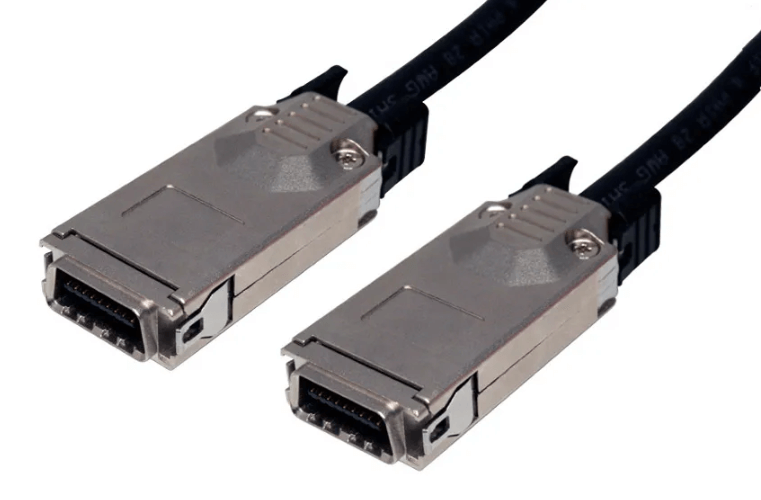
CX4 connectors are heavier than later small form factor interfaces. The mass of the cable and strain from routing can introduce torque at the port. Without positive retention features, even minor movement may cause gradual loosening. Thumbscrews provide threaded engagement between the connector shell and the host receptacle, applying consistent clamping force. Integrated latch features add secondary retention, reducing the likelihood of partial disengagement during servicing of adjacent ports.
Interface Stability and Electrical Continuity
CX4 links carry multiple high speed differential pairs that operate at frequencies where impedance control is critical. Stable physical mating ensures uniform contact pressure across signal pins and ground references. Any shift in connector alignment can alter impedance characteristics, increasing insertion loss or reflection.
Mechanical retention directly supports signal integrity by maintaining full seating depth and proper shell to chassis bonding. Consistent bonding improves shielding effectiveness and reduces susceptibility to electromagnetic interference within crowded rack environments. For 10GbE and InfiniBand deployments near the practical distance limits of copper cabling, small mechanical deviations can translate into measurable degradation.
Redundancy in Retention Mechanisms
The combined use of thumbscrews and latch arms provides layered protection. Thumbscrews resist gradual loosening due to vibration, while latches prevent unintended release during manual cable handling. This redundancy is particularly important in racks that undergo frequent reconfiguration or hardware replacement.
Because CX4 systems were often deployed during transitional periods in data center evolution, mechanical tolerances could vary between vendors. Adjustable screw engagement compensates for minor dimensional differences, allowing secure mating across diverse switch and adapter designs.
Long Term Operational Reliability
Continuous vibration, airflow turbulence, and cable weight can cause fretting wear at electrical contacts if connectors are not firmly secured. Properly tightened thumbscrews minimize micro movement at the mating interface, reducing the risk of intermittent link behavior over time. Latches simplify service events by enabling controlled release without excessive force that might stress the port housing.
In environments where uptime is critical, preventing unplanned link drops is a primary objective. Mechanical retention in CX4 assemblies contributes directly to that objective by stabilizing the physical layer.
Common Deployment Environments
-
Top of rack Ethernet switches using 10GbE CX4 interfaces
-
InfiniBand interconnects in compute clusters
-
Legacy server network adapters
-
Storage uplinks in early generation SAN infrastructure
-
Lab and validation platforms with repeated cable changes
Best Practices for Installation
Ensure thumbscrews are tightened evenly on both sides to avoid connector skew. Apply sufficient torque to achieve firm engagement without overstressing the port threads. Route cables to minimize downward strain and avoid sharp bends near the connector exit. After maintenance, verify that latch arms are fully engaged and that there is no visible gap between the connector shell and the host port. Periodic visual inspection in high vibration racks helps confirm continued retention integrity.
FAQ (Frequently Asked Questions)
Can a CX4 link operate if the thumbscrews are not tightened?
A link may initially establish, but the connection becomes more vulnerable to vibration induced movement and potential signal instability.
Are latch mechanisms alone adequate for long term retention?
Latch arms provide quick engagement, but threaded retention significantly improves resistance to gradual loosening in vibration prone environments.
Does mechanical retention influence signal integrity?
Yes. Stable seating preserves contact pressure, controlled impedance, and effective shielding, all of which affect high speed performance.
Are CX4 retention features consistent across manufacturers?
Most implementations follow similar mechanical standards, though minor dimensional variations can exist between vendors.