OCuLink 8x to Dual 4x Breakout Cables for NVMe Storage Scaling
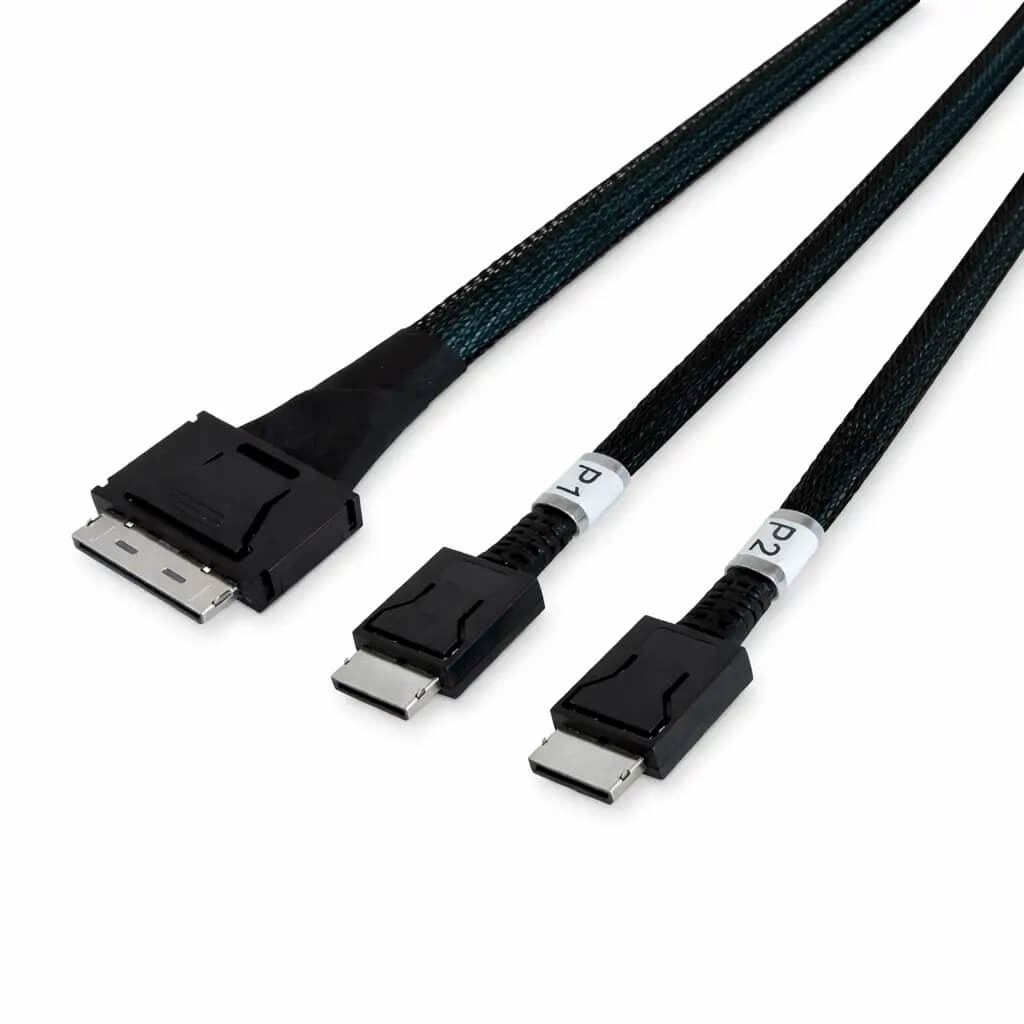
OCuLink 8x to dual 4x breakout cables are used to expand NVMe device connectivity in systems with limited PCIe port availability. These assemblies split a single x8 PCIe interface into two independent x4 links, enabling multiple NVMe drives or backplane connections from one host port. They are commonly deployed in servers and storage platforms where high density device integration and efficient lane utilization are required.
PCIe Lane Allocation and Bifurcation
PCIe communication is based on groups of differential lanes, with each lane supporting bidirectional data transfer. NVMe drives typically operate on x4 links, providing a balance between bandwidth and lane efficiency.
An OCuLink x8 interface carries eight PCIe lanes from the host system. When the platform supports PCIe bifurcation, these lanes can be divided into two independent x4 connections. The breakout cable distributes these lanes to two device side connectors, allowing each NVMe device to function as a separate endpoint.
This configuration enables increased device count without reducing the bandwidth available to each drive.
Breakout Cable Electrical Architecture
OCuLink breakout cables are passive assemblies constructed with high speed twinax copper conductors. The cable is designed to maintain controlled impedance, consistent pair geometry, and effective shielding across all lanes.
In an x8 to dual x4 configuration, the cable internally separates the eight lanes into two groups. Each group is routed to a dedicated connector, forming a complete x4 PCIe channel.
Because the cable performs no active processing, all link negotiation and management remain under the control of the host system.
Signal Integrity and Performance Considerations
Maintaining signal integrity is critical for stable PCIe operation at modern data rates. Breakout cables must preserve electrical characteristics across both branches to ensure reliable communication.
Key factors include:
- Controlled impedance across all differential pairs
- Minimal crosstalk between adjacent lane groups
- Stable timing alignment within each x4 channel
- Shielding to reduce external interference
Proper cable construction ensures that splitting the x8 interface does not introduce performance degradation.
Advantages for NVMe Storage Platforms
Breakout cables provide an efficient method for scaling NVMe storage without increasing the number of controller ports. By dividing a single x8 interface into two x4 links, systems can support additional drives while maintaining direct PCIe connectivity.
This approach reduces hardware complexity and avoids the need for additional switching components, making it suitable for high density storage designs.
Use in Backplanes and Modular Systems
Many NVMe backplanes and modular storage platforms are designed around x4 PCIe connections. OCuLink breakout cables allow direct connection from a host controller to multiple backplane inputs.
Each connected device receives a dedicated x4 link, preserving independent communication and simplifying system architecture. This is particularly useful in modular server designs where storage configurations may change over time.
Comparison with PCIe Switch Based Expansion
PCIe switches provide an alternative method for connecting multiple devices through a single host interface. While switches offer dynamic bandwidth allocation, they introduce additional hardware, power requirements, and potential latency.
Breakout cables offer a simpler solution when fixed lane allocation is sufficient. For many NVMe deployments, splitting an x8 interface into two x4 links provides predictable performance with lower system complexity.
Typical Deployment Environments
OCuLink breakout cables are commonly used in:
- NVMe storage backplanes
- High density server platforms
- PCIe storage expansion systems
- Modular NVMe drive carriers
- Storage development and validation labs
These environments benefit from increased device connectivity while maintaining direct PCIe communication.
Installation and Design Best Practices
Verify that the host system supports PCIe bifurcation before deployment. Without this capability, the breakout configuration will not function correctly.
Select cable lengths appropriate for the system layout to minimize signal loss and excess slack. Maintain proper bend radius and avoid mechanical strain on connectors. Organized cable routing helps preserve airflow and long term reliability.
FAQ (Frequently Asked Questions)
Do breakout cables reduce NVMe performance?
No. Each device receives a dedicated x4 PCIe connection, which is standard for NVMe drives.
Is PCIe bifurcation required for these cables?
Yes, the host system must support bifurcation to split the x8 interface.
Are OCuLink breakout cables active components?
No, they are passive and rely on the host for signal management.
Where are these cables typically used?
They are used in NVMe storage systems, server platforms, and PCIe expansion environments.