Connector Orientation and LSZH Materials in SATA Cables for Compact Systems
Internal storage systems often rely on Serial ATA connections to link drives with host controllers inside servers, workstations, and embedded hardware. In compact platforms, the design of SATA cables must accommodate both limited physical space and material safety requirements. Connector orientation affects how cables can be routed within dense enclosures, while LSZH jacket materials address safety concerns related to smoke generation and halogen emissions in regulated environments.
SATA Connectivity in Space Constrained Systems
Serial ATA technology uses dedicated point-to-point copper links between a storage device and a controller interface. Because these connections operate at data rates up to 6 Gb/s in SATA III implementations, maintaining short cable paths and controlled routing is important for signal integrity.
Compact system architectures frequently include tightly packed drive bays, restricted airflow channels, and minimal clearance behind storage devices. In such layouts, the cable geometry and exit direction from the connector housing influence whether a connection can be made without interfering with adjacent components. Selecting the correct connector orientation helps maintain stable mechanical connections and prevents excessive stress on the drive port.
Connector Orientation and Routing Behavior
The direction in which a cable exits a SATA connector determines how the cable will travel within the enclosure. Systems with dense hardware layouts often require different orientations depending on the position of the storage device or controller port.
Straight connector configurations
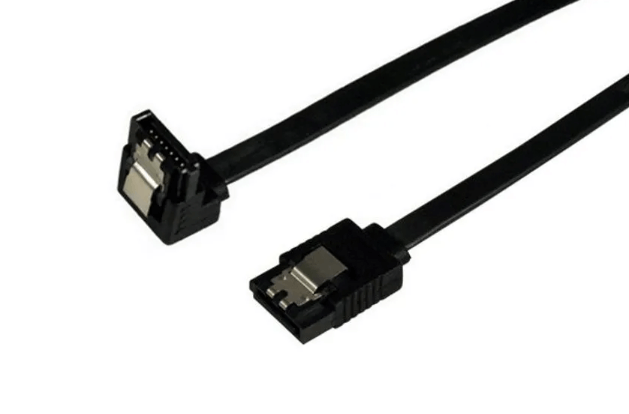
Straight SATA connectors extend directly outward from the interface. This orientation is suitable for installations where sufficient clearance exists behind the drive or motherboard port. Straight connectors simplify installation and removal because the cable follows a direct path without immediately changing direction.
In systems with open internal layouts or vertically oriented drive bays, straight connectors allow cables to route upward or toward designated cable management channels.
Right angle connector configurations
Right angle connectors redirect the cable along the plane of the device surface. By changing the cable direction immediately at the connector housing, this design reduces the space required behind the drive interface.
This configuration is commonly used in shallow drive cages or compact enclosures where vertical clearance is minimal. Routing the cable parallel to the drive surface can also help maintain unobstructed airflow paths within the chassis.
LSZH Jacket Materials and Fire Safety Considerations
Low smoke, zero halogen cable jackets are designed to reduce hazardous emissions during combustion events. When exposed to high temperatures, LSZH materials generate significantly less smoke and do not release corrosive halogen gases.
These properties are valuable in equipment rooms, shared ventilation systems, and facilities governed by strict fire safety standards. In dense computing environments, limiting smoke production helps maintain visibility and reduces the potential for secondary damage to nearby electronics.
Although LSZH jackets can feel slightly firmer than traditional PVC insulation, proper cable routing and bend radius management prevent mechanical stress. The jacket material itself does not influence the electrical characteristics of the SATA interface.
Compatibility and Operational Environments
LSZH SATA cables remain fully compatible with standard SATA drives and host adapters. The cable assembly simply carries differential signals between devices, meaning performance characteristics are defined by the SATA protocol generation and the connected hardware.
These cables are widely deployed in enterprise servers, telecommunications systems, industrial computers, and network appliances. Environments that combine high hardware density with safety compliance requirements frequently adopt LSZH cabling as part of their infrastructure design.
Common Use Cases
-
Internal storage connections in servers and workstation platforms
-
Compact or shallow chassis designs with limited connector clearance
-
Data center hardware requiring LSZH compliant cable materials
-
High density drive cages and storage backplanes
-
Industrial or telecommunications systems with strict safety standards
Installation and Routing Considerations
Selecting the appropriate connector orientation should be based on the physical layout of the enclosure. Drives mounted close to chassis walls or cooling channels may require right angle connectors to avoid interference.
Cables should be routed away from sharp metal edges and should maintain the minimum bend radius specified by the manufacturer. Maintaining consistent cable orientation across multiple drive bays simplifies maintenance and helps technicians quickly identify connections during service procedures.
FAQ (Frequently Asked Questions)
Why are different connector orientations used in SATA cables?
Connector orientation determines how the cable exits the drive or host port, allowing installers to adapt cable routing to available space within the enclosure.
Does LSZH insulation affect SATA signal transmission?
No. The electrical performance of the SATA link remains unchanged because the jacket material only surrounds the conductors.
Can right angle and straight connectors be mixed in the same system?
Yes. Many systems use straight connectors on motherboard ports and right angle connectors on drives to optimize routing.
Are LSZH cables required for all SATA installations?
They are required only where safety standards or building regulations specify LSZH materials, although many organizations adopt them as a precaution.