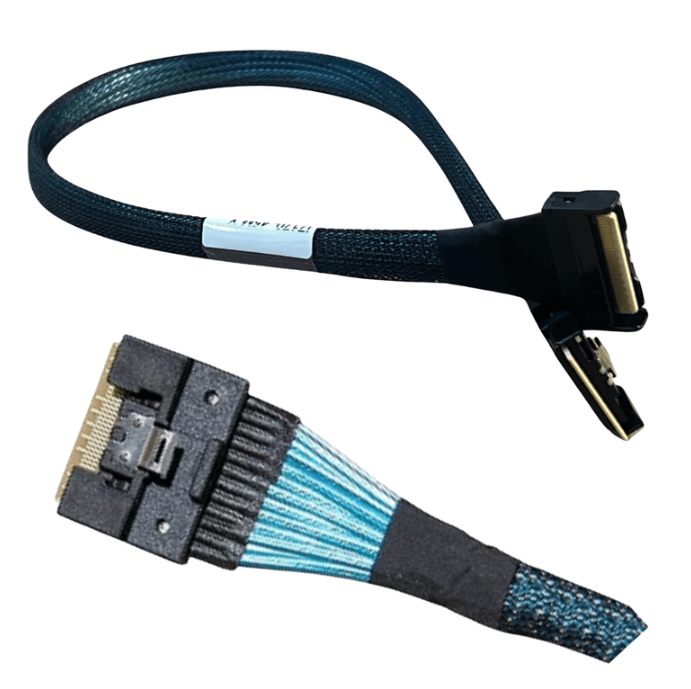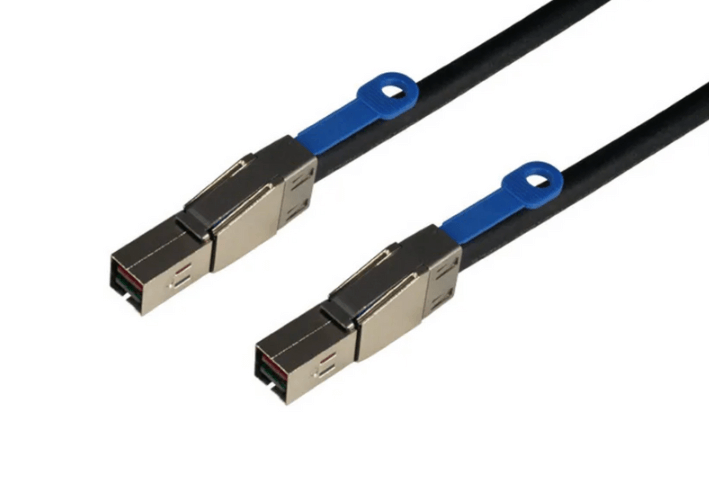
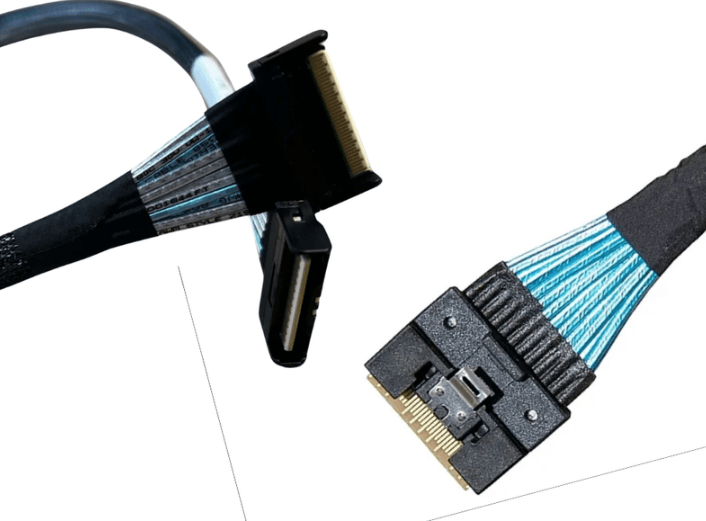
How Do MCIO And SlimSAS Compare For Performance, Pinouts, And Use Cases
MCIO and SlimSAS are both modern high-speed internal interconnect standards designed to support PCIe Gen 4 and Gen 5 signaling in dense server and storage platforms. While they overlap in capability, they were created with different architectural priorities in mind. Understanding how they compare in performance, pinout structure, and real-world use cases helps determine which connector best fits a given system design.
Performance and Bandwidth Capabilities
From a per-lane perspective, MCIO and SlimSAS support similar signaling speeds. Both are capable of carrying PCIe Gen 4 at 16 GT per second per lane and PCIe Gen 5 at 32 GT per second per lane, as well as high-speed SAS where applicable.
The main performance difference lies in lane aggregation.
SlimSAS is typically available in 4 lane and 8 lane internal configurations. This makes it well suited for storage workloads where connections are naturally grouped in four lane increments, such as NVMe drives or SAS backplanes.
MCIO supports a wider range of lane counts, including x4, x8, x16, and higher density variants depending on implementation. This allows significantly more aggregate bandwidth to be delivered through a single connector, which is valuable in CPU to backplane, PCIe switch, and accelerator focused designs.
In short, raw per-lane speed is similar, but MCIO enables higher total bandwidth per connector.
Pinouts and Electrical Complexity
SlimSAS pinouts are defined under the SFF-8654 specification. The standard is relatively straightforward, with clearly defined 4i and 8i mappings that are widely implemented across storage backplanes, HBAs, and cable assemblies.
This simplicity makes SlimSAS easier to integrate, validate, and troubleshoot. Lane mapping is predictable, and breakout options are well established.
MCIO pinouts, defined under the SFF-TA-1016 specification, are more complex. MCIO supports many more lane configurations and often includes additional sideband signals and control pins. This flexibility enables advanced system level designs, but it also increases design complexity.
MCIO pinouts are typically used in tightly integrated platforms where the motherboard, backplane, and cabling are designed together rather than mixed across vendors.
Connector Size and Routing Density
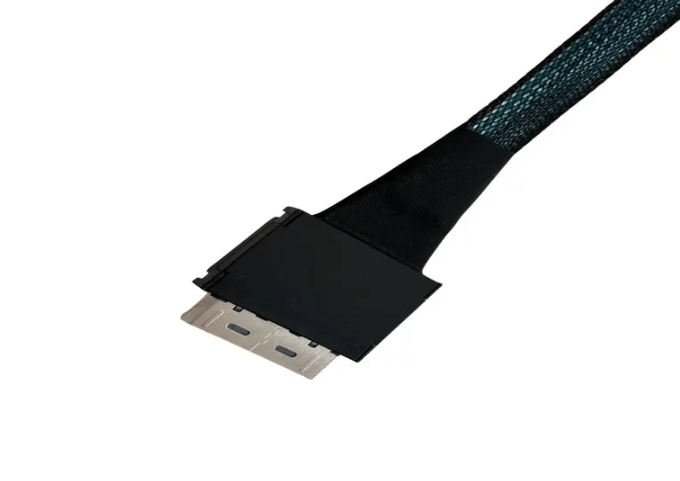
Both connectors are designed for compact, high density environments, but MCIO has a smaller footprint.
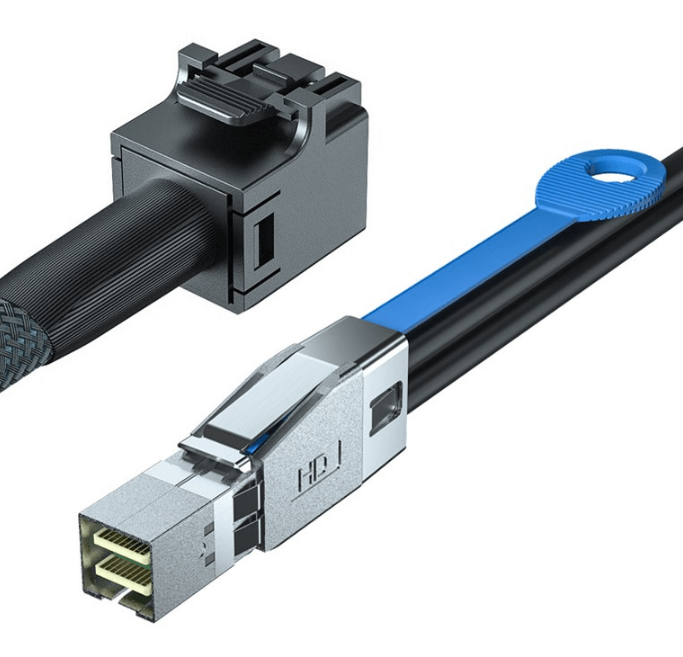
SlimSAS already represents a significant reduction compared to older HD MiniSAS connectors and works well in dense storage chassis. MCIO goes a step further, allowing even more connectors or lanes to be placed in the same PCB area.
This difference matters most in ultra-dense designs, such as PCIe switch fabrics, AI compute nodes, and multi-accelerator systems, where board edge space and airflow clearance are extremely constrained.
For many storage focused systems, SlimSAS density is sufficient. For compute heavy platforms, MCIO often provides needed headroom.
Signal Integrity Considerations
Both standards are engineered for high frequency signaling, but MCIO was designed specifically with PCIe Gen 5 and future generations as a primary target.
SlimSAS performs very well at Gen 4 and can support Gen 5 with appropriate cable length and routing discipline. However, because it aggregates fewer lanes per connector, more connectors and cables may be required in very high bandwidth systems.
MCIO reduces the total number of connector transitions by consolidating lanes. Fewer transitions can improve overall channel margin, which is one reason MCIO is favored in Gen 5 backplanes and switch based architectures.
Typical Use Cases for SlimSAS
SlimSAS is most commonly used in storage centric designs where clarity, modularity, and ecosystem support are priorities.
Typical SlimSAS use cases include:
-
NVMe drive backplanes
-
SAS and hybrid SAS or NVMe storage enclosures
-
JBOD systems
-
RAID and HBA connections
-
Breakouts to SATA, SAS, or U.2 drives
Its well defined pinouts, wide availability, and simpler integration make it ideal for platforms where storage connectivity is the main goal.
Typical Use Cases for MCIO
MCIO is favored in designs that prioritize extreme density, wide PCIe links, and tight integration.
Common MCIO use cases include:
-
CPU to PCIe switch backplanes
-
Accelerator and GPU dense systems
-
AI and HPC platforms
-
Composable infrastructure
-
Next generation Gen 5 and future Gen 6 designs
These systems benefit from MCIO’s ability to deliver many lanes through a single compact connector.
Ecosystem Maturity and Adoption
SlimSAS has a larger installed base today, especially in enterprise storage. Cables, breakouts, and compatible backplanes are readily available from many vendors.
MCIO adoption is accelerating rapidly but is still more common in new platform designs rather than upgrades. Its ecosystem is growing fastest among OEMs building next generation compute and AI systems.
This difference affects procurement and deployment. SlimSAS is easier to drop into mixed environments, while MCIO is best suited to purpose built platforms.
Choosing Between MCIO and SlimSAS
SlimSAS is usually the better choice when:
-
The system is storage focused
-
Lane counts are naturally x4 or x8
-
Broad compatibility and modularity are needed
-
Integration simplicity is important
MCIO is usually the better choice when:
-
Very high aggregate bandwidth is required
-
Board space and airflow are extremely constrained
-
PCIe switch or accelerator fabrics dominate the design
-
The platform targets Gen 5 and beyond from the outset
Neither connector is universally better. Each is optimized for a different architectural priority.
FAQ (Frequently Asked Questions)
Is MCIO faster than SlimSAS per lane?
No. Per-lane speed is similar. MCIO supports higher total bandwidth by aggregating more lanes.
Can MCIO replace SlimSAS in storage systems?
It can, but SlimSAS is often simpler and more practical for traditional storage backplanes.
Are MCIO and SlimSAS compatible with each other?
They are not directly compatible. Interoperability requires specifically designed adapter cables or backplanes.
Which is more future-proof?
MCIO offers more headroom for future PCIe generations, but SlimSAS remains highly relevant for storage platforms.