Electrical Signal Mapping in HD50 to CEN50 SCSI Adapter Connections
HD50 to CEN50 SCSI adapters provide connector conversion between two physical interfaces that carry the same 50-pin parallel SCSI signal set. These adapters are used when systems must connect devices equipped with High Density 50-pin ports to peripherals that use the Centronics 50-pin connector format. Because the electrical signaling remains identical across both interfaces, the adapter maintains direct signal continuity while only altering the mechanical connection format.
HD50 and CEN50 Connector Structures
The HD50 connector is a compact high density interface designed to accommodate 50 signal pins in a smaller footprint. It typically appears on host adapters and controllers that were introduced in later generations of parallel SCSI hardware. The reduced connector size allows for higher port density on expansion cards and storage controllers.
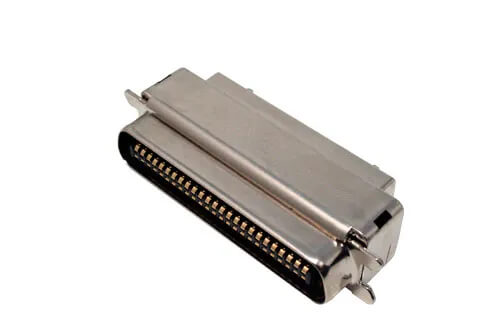
The CEN50 connector, often referred to as Centronics 50, uses a larger rectangular housing and spring latch retention mechanism. Earlier external SCSI devices frequently used this interface because it provided durable shielding and secure attachment for external cable connections.
Although these connectors differ in size and retention style, both formats carry the same electrical signals used by narrow parallel SCSI implementations.
Signal Mapping Across Connector Formats
Parallel SCSI communication utilizes multiple conductors that simultaneously carry data, control signals, and grounding paths. For compatibility between connector types, each signal line must be mapped directly between the HD50 and CEN50 pin assignments.
HD50 to CEN50 adapters preserve this mapping by connecting each pin from the high density interface to its corresponding Centronics contact. The adapter maintains the same wiring scheme defined for standard 8-bit SCSI configurations. This includes lines used for data transmission, device selection, arbitration, command control, and signal return paths.
Because the adapter performs no electrical translation, all protocol behavior remains determined by the connected SCSI devices and host controller.
Maintaining Electrical Integrity in Adapter Connections
Reliable SCSI communication depends on maintaining stable electrical characteristics across the entire cable path. Any discontinuity in impedance or shielding can introduce reflections or noise that interfere with parallel signal timing.
Well designed adapters maintain consistent conductor routing and shielding continuity to minimize these effects. The internal layout of the adapter must preserve signal pair relationships and maintain grounding paths that support the bus architecture.
Although adapters introduce an additional connection point, careful construction helps limit the impact on signal integrity within the supported cable length limits of the SCSI standard.
Role in Legacy SCSI Infrastructure
HD50 to CEN50 adapters are often deployed when upgrading or maintaining legacy storage infrastructure. Host adapters or controllers may provide HD50 connectors, while older peripherals such as tape drives or disk enclosures continue to rely on Centronics interfaces.
By preserving signal compatibility, the adapter allows these devices to operate within the same SCSI bus without requiring replacement hardware. This approach helps extend the operational life of legacy equipment while maintaining interoperability within the storage system.
Common Use Cases
-
Connecting HD50 host adapters to CEN50 external SCSI devices
-
Integrating legacy tape drives into existing SCSI environments
-
Maintaining older disk enclosures with updated controllers
-
Supporting mixed connector formats within parallel SCSI systems
-
Preserving compatibility across generations of SCSI hardware
Installation and Handling Considerations
Adapters should be installed with attention to connector retention mechanisms. HD50 interfaces generally use screw locking hardware, while CEN50 connectors rely on latch clips to secure the connection.
Avoid applying mechanical stress to the adapter body, particularly when heavy external cables are attached. Cable management supports can reduce strain and help maintain stable electrical connections.
Documenting connector conversions within system diagrams can simplify troubleshooting and maintenance when multiple SCSI devices are connected along the same bus.
FAQ (Frequently Asked Questions)
Does an HD50 to CEN50 adapter alter SCSI communication protocols?
No. The adapter only converts the physical connector format while preserving the existing SCSI signaling.
Are these adapters compatible with all 50-pin SCSI implementations?
They are compatible with standard narrow parallel SCSI devices that use the same signal assignments.
Do HD50 to CEN50 adapters contain active electronics?
No. These adapters are passive and provide direct pin-to-pin electrical continuity.
Is bus termination provided by the adapter?
Termination is normally handled by dedicated terminators or built into devices at the ends of the SCSI chain.