How HD MiniSAS Breakout Cables Work From SFF-8644 To Internal Ports
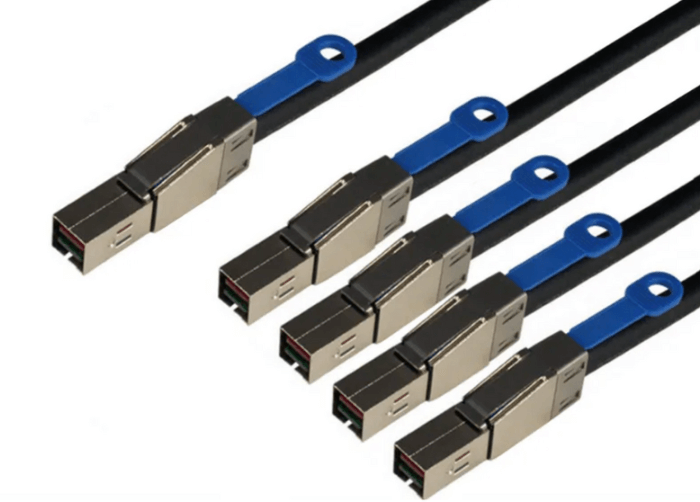
HD MiniSAS breakout cables are used to fan out a single external SFF-8644 port into multiple internal SAS connections inside a chassis. They are common in storage expansion, JBODs, and mixed generation environments where an external controller must interface cleanly with internal backplanes or drive cages. Understanding how these breakouts distribute lanes and preserve protocol integrity helps ensure correct device detection and reliable performance.
What an SFF-8644 HD MiniSAS Breakout Does
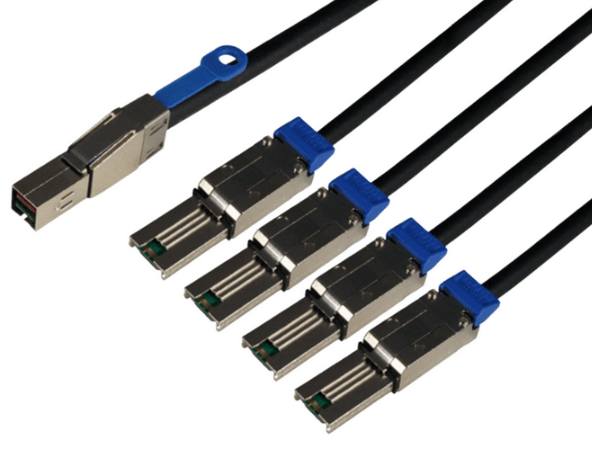
An SFF-8644 breakout cable takes the lanes from one external HD MiniSAS port and routes them to multiple internal connectors. Electrically, the cable performs no protocol conversion. It simply redistributes the existing SAS lanes from the host to downstream targets.
Depending on the design, the external port can break out to two or four internal connectors. Each internal connector represents a group of lanes taken directly from the external port.
Lane Structure and Distribution
A single SFF-8644 port carries four SAS lanes. In breakout assemblies that terminate in multiple internal ports, lane distribution is handled by grouping lanes across connectors.
In a two port breakout, each internal connector typically receives two lanes. In a four port breakout, each internal connector receives one lane. The exact mapping depends on the cable design and the intended use case.
This lane allocation is fixed in the cable. It must align with how the controller and backplane expect lanes to be presented, otherwise devices may not enumerate correctly.
Internal Connector Types Used in Breakouts
HD MiniSAS breakout cables commonly terminate in one of two internal connector types.
SFF-8643 is the internal HD MiniSAS connector. It is widely used in SAS 3.0 backplanes and supports compact, high density internal layouts.
SFF-8087 is the older internal MiniSAS connector. It is still common in legacy SAS 2.0 and early SAS 3.0 systems.
The choice between these internal connectors depends entirely on the backplane or device being connected. The external SFF-8644 port can be the same in both cases.
Forward Breakout Direction and Data Flow
HD MiniSAS breakout cables used in storage systems are forward breakouts. This means they distribute lanes from a host or controller port to multiple internal targets.
The direction is important. Reverse breakouts, which aggregate lanes from multiple internal connectors into one external port, are electrically different and are not interchangeable. Using the wrong breakout direction will prevent communication even if the connectors fit.
Protocol Behavior and Compatibility
These breakout cables are designed for SAS signaling, typically SAS 2.0 or SAS 3.0. They may support SATA drives through SAS controllers that allow SATA tunneling, but they are not intended for PCIe or NVMe signaling.
Because the cable does not change the protocol, the host controller must already support the devices being connected. A SAS controller with an SFF-8644 port will see the downstream devices exactly as if they were connected through a backplane.
Why Multiple Internal Ports are Useful
Breaking out one external port into multiple internal connections allows a single controller port to serve several backplanes, drive cages, or expander inputs. This reduces the number of external cables required and simplifies routing.
It is especially useful when retrofitting newer controllers into older chassis or when consolidating cabling in dense storage systems.
Signal Integrity Considerations
Although HD MiniSAS is designed for high speed operation, breakout cables introduce additional branch points. This makes signal integrity more sensitive to cable length and quality.
Short, well shielded breakout assemblies are preferred. Excessive length or poor routing can increase attenuation and crosstalk, especially at 12 gigabits per second per lane.
Common Deployment Scenarios
HD MiniSAS SFF-8644 breakout cables are commonly used in:
-
External RAID or HBA connections to internal backplanes
-
JBOD and storage expansion enclosures
-
Mixed generation SAS environments
-
Server retrofits using newer external controllers
In each case, the breakout allows efficient use of a single external port.
Verification Before Installation
Before deploying a breakout cable, verify the following:
-
External port type and lane count on the controller
-
Internal connector type required by the backplane
-
Breakout direction is forward, not reverse
-
Supported SAS generation and speed
-
Lane mapping matches the backplane design
Confirming these details prevents costly troubleshooting after installation.
FAQ (Frequently Asked Questions)
Do HD MiniSAS breakout cables convert SAS to SATA or PCIe?
No. They only redistribute existing SAS lanes.
Can one breakout support mixed internal connector types?
Not typically. Breakouts are built with a single internal connector type per cable.
Does a four port breakout provide more bandwidth than a two port breakout?
No. Total bandwidth is limited by the four lanes of the external port.
Are SFF-8644 breakout cables hot swappable?
That depends on the controller and system design, not the cable itself.