Electrical and Power Distribution Considerations for SlimSAS 4i SAS Breakout Cables
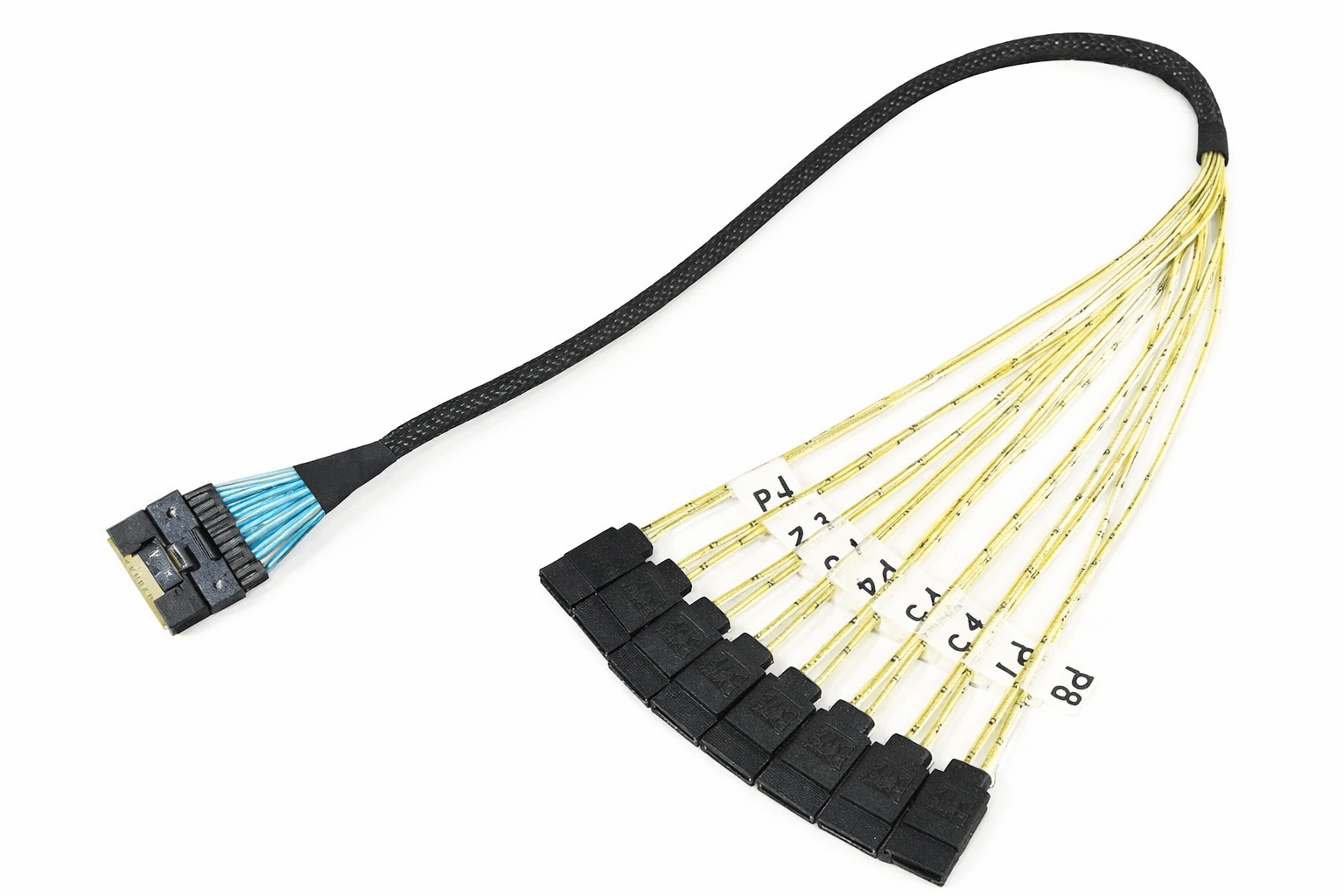
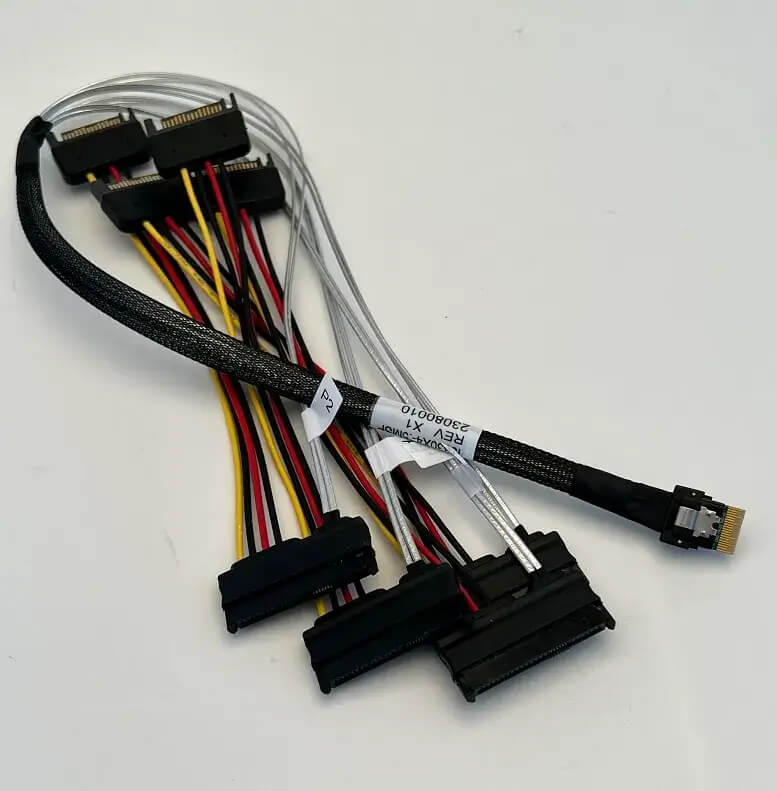
SlimSAS 4i to 4x SAS breakout cables provide a compact interconnect method for attaching multiple SAS drives to a single host interface. Using the SFF-8654 SlimSAS connector, these assemblies enable four independent data links from one controller port to individual drives. They are commonly used in servers, workstation storage platforms, and compact systems where port density, bandwidth efficiency, and controlled power delivery must coexist within limited chassis space.
SlimSAS 4i Lane Architecture and SAS Communication
The SlimSAS 4i interface provides four high speed differential lanes designed to support SAS or SATA signaling. In direct attach configurations, each differential pair connects to a separate drive interface such as SFF-8680, enabling independent communication between the controller and each device.
Within the SAS protocol stack, the controller manages device addressing, command execution, and error recovery. Each connected drive negotiates its link speed individually, commonly reaching up to 12 Gb/s under SAS 3.0 specifications. The breakout cable maintains dedicated lane separation, allowing each drive to operate through its own point-to-point connection.
Unlike expander-based topologies, this configuration prevents bandwidth sharing across drives and allows each device to access the full performance capacity of its assigned lane.
Signal Integrity Requirements for High Speed SAS Links
Reliable multi-gigabit signaling depends on maintaining electrical stability across the entire cable assembly. SlimSAS breakout cables are engineered with controlled impedance differential pairs to minimize reflections and insertion loss that could degrade link quality.
Important electrical considerations include:
-
Consistent differential pair impedance
-
Minimal skew between paired conductors
-
Effective shielding to limit crosstalk between adjacent lanes
-
Cable length within SAS specification limits
Maintaining these characteristics helps preserve signal quality and stable link training between the host controller and attached drives. Proper cable routing and avoidance of excessive mechanical stress further support long term signal reliability.
Integrated SATA Power Distribution
Many SlimSAS breakout assemblies include SATA style power connectors to supply voltage to individual drives alongside the data connections. Although SAS drives use SFF-8680 data interfaces, their power inputs often follow the SATA 15-pin format.
Design factors for reliable power distribution include:
-
Adequate conductor sizing for current delivery
-
Stable voltage supply across 3.3 V, 5 V, and 12 V rails where required
-
Secure crimping and connector termination
-
Harness layout that avoids airflow obstruction
Separating power conductors from high speed data pairs inside the harness reduces the risk of electromagnetic interference and supports consistent signal performance.
Mechanical Density and Chassis Layout Constraints
SlimSAS connectors provide higher port density compared with earlier MiniSAS interfaces, allowing system designers to place more storage ports within limited motherboard space. This is especially valuable in 1U and 2U servers where airflow and component clearance are tightly managed.
Effective cable routing contributes to both cooling efficiency and serviceability. Careful placement helps maintain airflow channels and prevents mechanical strain on connectors.
Recommended layout practices include:
-
Routing cables along designated airflow paths
-
Maintaining bend radius near SlimSAS connectors
-
Securing cable branches to prevent connector stress
-
Avoiding routing near high temperature components such as processors or voltage regulators
These practices support both thermal management and long term connector reliability.
Typical Deployment Environments
SlimSAS 4i breakout cables are commonly deployed in:
-
Rack-mounted enterprise servers
-
Compact storage appliances
-
High performance workstation systems
-
Edge computing nodes with multiple SAS drives
-
Development platforms used for SAS device testing
These environments benefit from the cable’s ability to provide multiple drive connections from a single high density controller port.
Best Practices for Implementation
For stable integration of SlimSAS breakout cables:
-
Confirm the controller supports direct attach SAS through SFF-8654
-
Match cable length to enclosure depth to avoid excess slack
-
Verify firmware compatibility between the controller and drives
-
Ensure both data and power connectors are fully seated
-
Keep power wiring separated from high speed signal bundles
Attention to both electrical and mechanical factors helps maintain consistent throughput and reliable drive communication.
FAQ (Frequently Asked Questions)
Can SlimSAS 4i breakout cables support both SAS and SATA drives?
Many SAS controllers support communication with SATA devices, but cable design and controller capabilities determine compatibility.
What is the maximum data rate supported by SlimSAS 4i connections?
Under SAS 3.0 specifications, each lane can support up to 12 Gb/s when used with compatible controllers and drives.
Does integrated SATA power affect signal integrity?
When properly designed, power conductors are isolated from high speed data pairs to prevent interference.
Are SlimSAS 4i breakout cables used with SAS expanders?
These cables are typically used for direct drive attachment rather than expander-based backplane architectures.