Why Do Modern Data Centers Deploy Active Optical Cables Instead Of DAC?
Active Optical Cables, commonly referred to as AOCs, are increasingly deployed in modern data centers as a replacement for Direct Attach Copper cables. Both technologies are used for short range, high speed interconnects between switches, servers, and storage platforms. The shift toward AOCs is driven by scaling challenges in bandwidth, distance, signal integrity, and physical cable management as data center densities continue to increase.
How AOCs and DACs Differ at a Physical Level
Direct Attach Copper cables rely entirely on electrical signaling over twinax copper conductors. As data rates increase, copper links become more sensitive to attenuation, crosstalk, and electromagnetic interference. These limitations restrict usable cable length and increase power requirements for signal conditioning.
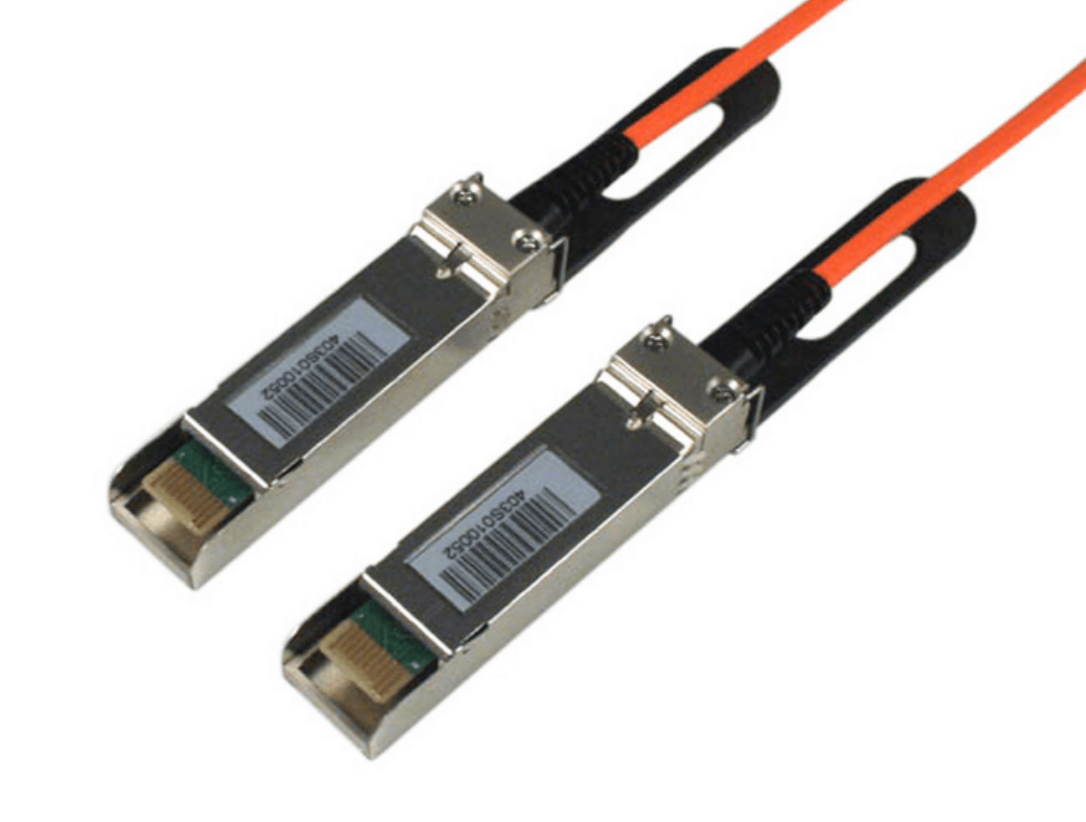
Active Optical Cables convert electrical signals into optical signals within the connector housing. The data is transmitted as light over optical fiber and converted back to electrical signals at the far end. By shifting transmission to the optical domain, AOCs avoid many of the physical constraints inherent to copper media.
Signal Integrity and Distance Limitations
One of the primary reasons data centers move away from DAC is signal integrity over distance. Passive DAC assemblies are typically limited to very short reaches at higher data rates. Active copper variants extend reach slightly but introduce additional power draw and thermal load.
AOCs maintain consistent signal quality over longer distances because optical fiber is not affected by resistance or external electrical noise. This makes AOCs well suited for inter rack and end of row architectures where link lengths exceed the practical limits of copper.
Bandwidth Scaling and Future Readiness
As Ethernet and InfiniBand speeds have advanced from 10G to 25G, 50G, and 100G per lane, copper cabling has become increasingly difficult to scale. Higher data rates demand tighter signal margins and more complex equalization.
AOCs are inherently better aligned with these bandwidth increases. Optical transmission supports higher aggregate throughput with lower bit error rates, allowing data center operators to deploy faster links without redesigning cable pathways or shortening runs.
Cable Density, Airflow, and Physical Management
Modern data centers prioritize high port density and efficient airflow. Copper DAC cables are thick, heavy, and stiff, which complicates routing in crowded racks and obstructs cooling paths.
Active Optical Cables use lightweight fiber ribbon assemblies that are thinner and more flexible. This simplifies cable management, reduces mechanical stress on ports, and improves airflow within racks and cable trays. These physical advantages become increasingly important as switch port counts grow.
Power Consumption and Thermal Considerations
At higher speeds and longer distances, copper solutions require more electrical power to maintain acceptable signal quality. This added power contributes directly to heat generation at the switch port level.
AOCs consume power within their embedded optical transceivers, but overall thermal impact is often lower than equivalent active copper solutions for longer reaches. Reduced heat at the port level supports higher port densities and improves long term hardware reliability.
Typical Use Cases Favoring AOCs Over DAC
Active Optical Cables are commonly deployed in the following environments:
-
Leaf spine and spine spine switch interconnects
-
End of row to top of rack connections
-
High performance computing clusters
-
AI and accelerator dense server deployments
-
Large scale data centers with modular rack layouts
DAC remains viable for very short, intra rack links where cost and simplicity outweigh performance constraints.
Deployment and Compatibility Considerations
AOCs are factory terminated assemblies and must be ordered at the correct length. They are not field serviceable and typically have fixed polarity and connector orientation. Careful planning is required to ensure compatibility with switch platforms, supported data rates, and firmware requirements.
Despite these considerations, many operators prefer AOCs because they eliminate the need for separate optical transceivers and fiber patching, reducing the number of connection points in the link.
FAQ (Frequently Asked Questions)
Are active optical cables compatible with standard QSFP and SFP ports?
Yes. AOCs are designed to plug directly into standard electrical ports and appear to the host system as a complete link rather than a removable transceiver.
Do AOCs support the same protocols as DAC cables?
In most cases, yes. AOCs support Ethernet, InfiniBand, and other high speed protocols depending on the specific cable design.
Why are DAC cables still used in some data centers?
DAC cables remain cost effective for very short distances and low to moderate speeds where signal integrity and cable bulk are less critical.
Can AOCs be reused when upgrading switches?
Reuse depends on port compatibility, supported speeds, and vendor interoperability. AOCs are generally less flexible than discrete optics during hardware transitions.