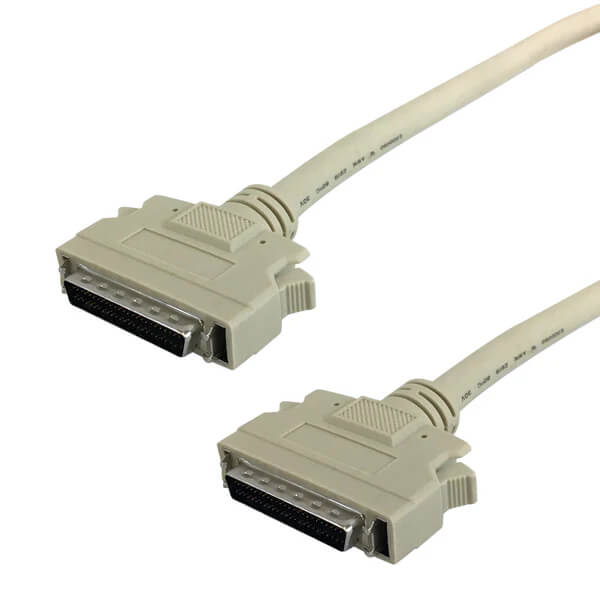
External HD50 to HD50 Cables for Narrow Parallel SCSI Interfaces
External HD50 to HD50 cables are 50-pin SCSI interconnect assemblies designed for narrow parallel SCSI communication between external devices and controllers. These cables are commonly used in legacy computing, storage, imaging, and industrial systems that operate on 8-bit SCSI architectures. The high density connector format enables reliable external connectivity while maintaining the electrical characteristics required for stable parallel bus operation.
HD50 Connector Structure and Mechanical Design
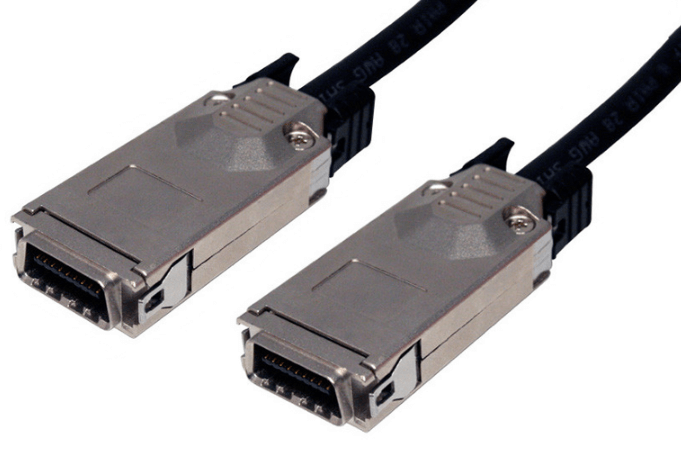
The HD50 connector, also known as High Density 50, uses a compact two row configuration with fifty contacts. This connector type was developed to reduce panel space compared with earlier Centronics style connectors while still providing a secure mechanical connection through threaded jack screws.
Typical cable construction elements include:
-
Controlled impedance or twisted pair internal conductors
-
Foil or braided shielding to reduce electromagnetic interference
-
Integrated drain wire to maintain consistent grounding
-
Molded or metal backshell strain relief
Metal backshell versions provide improved shielding effectiveness and additional structural strength. These designs are often used in rack-mounted systems or equipment that operates in environments where electromagnetic interference may be present.
Electrical Characteristics Of Narrow SCSI Signaling
HD50 to HD50 cables are associated with narrow SCSI standards, including SCSI 1, SCSI 2, and Fast SCSI. These interfaces use an 8-bit data path, which differs from later wide SCSI implementations that utilize a 16-bit bus.
Parallel SCSI operates using a shared electrical bus architecture. Multiple devices communicate along the same signal pathway, which makes impedance consistency and signal timing critical for reliable data transfer. Poor shielding, excessive cable length, or impedance discontinuities can introduce reflections that interfere with data integrity.
For stable operation, the SCSI bus must be properly terminated at both ends of the physical device chain. Termination absorbs signal reflections and helps maintain clean signal transitions across the bus.
Common Environments Where HD50 Cables Are Used
Although modern systems have largely transitioned to serial interfaces such as SAS and SATA, many specialized systems continue to rely on narrow SCSI connectivity. External HD50 to HD50 cables are often found in:
-
Legacy RAID controllers and storage arrays
-
Tape drives and removable media subsystems
-
Film scanning and digital imaging equipment
-
Industrial automation and control systems
-
Laboratory test and measurement platforms
These systems may remain in service for extended periods due to validated operational workflows, equipment certification requirements, or long hardware lifecycle expectations.
Cable Routing And Installation Considerations
Maintaining proper cable routing practices helps preserve signal quality in narrow SCSI environments. Bending cables sharply near connectors can place stress on internal conductors and shielding layers, which may degrade performance over time.
Connector jack screws should always be secured to prevent accidental disconnection or vibration-related loosening. In addition, routing SCSI cables away from high current power cables can reduce exposure to electromagnetic interference.
It is also important to confirm that the total SCSI bus length, including both internal and external cables, remains within the limits defined by the specific SCSI implementation.
Compatibility Considerations For Legacy Systems
HD50 to HD50 cables are designed for narrow SCSI interfaces where all devices share the same 8 bit bus width and compatible signaling mode. These cables cannot directly connect to 68 pin wide SCSI interfaces without adapters.
When maintaining or integrating legacy systems, verify several key parameters:
-
Controller port connector type
-
Device connector configuration
-
Supported SCSI signaling standard
-
Bus termination arrangement
Documenting the complete SCSI topology helps ensure consistent system behavior and simplifies future troubleshooting or equipment replacement.
FAQ (Frequently Asked Questions)
What type of SCSI systems use HD50 connectors?
HD50 connectors are commonly used in narrow 8 bit SCSI environments such as SCSI 1, SCSI 2, and Fast SCSI.
Are HD50 cables compatible with wide SCSI devices?
No. Wide SCSI systems use 68-pin connectors and operate on a 16-bit data bus. Adapters are required if both device types must coexist.
Why is termination necessary on a SCSI bus?
Termination prevents signal reflections at the ends of the shared SCSI bus and helps maintain stable data communication.
Why are HD50 cables still used today?
They are commonly used to maintain legacy storage systems, imaging equipment, and industrial platforms that were originally designed for narrow SCSI architectures.