What Makes SFP+ Active Optical Cables Suitable For Low Latency Network Connectivity?
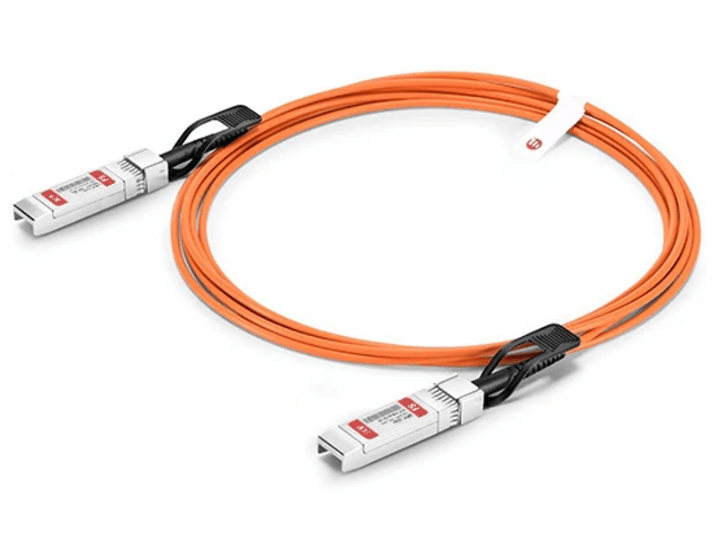
SFP+ Active Optical Cables are designed to provide stable, low latency connectivity for 10 Gb network links in environments where signal quality and predictable performance are critical. By integrating optical fiber and active electronics into a single SFP+ form factor assembly, these cables support longer reach and cleaner transmission than passive copper alternatives while maintaining compatibility with standard SFP+ ports.
Electrical And Optical Architecture
SFP+ Active Optical Cables convert electrical signals from the host port into optical signals within the connector housing. Data is transmitted over optical fiber for the length of the cable and converted back to electrical form at the far end. This architecture removes many of the electrical limitations associated with copper conductors, particularly attenuation, impedance variation, and susceptibility to external noise.
Signal Integrity And Error Reduction
Optical transmission is inherently immune to electromagnetic interference, which is a major factor in signal degradation within dense racks and cable trays. By eliminating EMI exposure, SFP+ AOCs reduce bit error rates and retransmission events. Fewer retransmissions contribute directly to more consistent latency characteristics, which is essential for latency sensitive workloads.
Latency Characteristics Of SFP+ AOCs
Although SFP+ AOCs contain active components, the optical conversion process introduces negligible delay. In practical deployments, the latency contribution of an AOC is typically lower than the variability introduced by copper signal degradation at longer distances. This results in stable, predictable end to end link behavior across the full supported cable length.
Distance And Performance Advantages
Passive copper SFP+ DAC cables are generally limited to short distances due to signal loss and crosstalk at 10 Gb speeds. SFP+ Active Optical Cables extend usable reach while maintaining full line rate performance. This allows network designers to place switches, servers, and storage systems with greater physical flexibility without sacrificing latency consistency.
Physical Cable Benefits
SFP+ AOCs are lighter and thinner than equivalent copper assemblies. Reduced cable mass lowers mechanical stress on ports and improves airflow within high density racks. Smaller cable diameters also simplify routing and reduce congestion, which helps maintain thermal efficiency and serviceability.
Common Low Latency Use Cases
SFP+ Active Optical Cables are commonly deployed in:
-
Top of rack to end of row switch links
-
Storage networks using iSCSI or similar protocols
-
East west traffic paths in data center fabrics
-
High density server interconnects
These scenarios benefit from consistent signal quality and minimized latency variation.
Installation And Compatibility Considerations
Proper bend radius management and careful handling are important to preserve optical performance. Compatibility with switch and server firmware should be verified, particularly in environments using vendor qualified optics. Clean handling practices help prevent contamination of optical interfaces during installation.
When Copper Remains Appropriate
Copper SFP+ DAC cables remain effective for very short reach connections within the same rack where signal margins are well controlled. In these cases, copper offers a lower cost solution without compromising latency requirements.
FAQ (Frequently Asked Questions)
Why do SFP+ Active Optical Cables provide more stable latency than copper?
They reduce signal degradation and retransmissions by using optical transmission that is immune to EMI.
Do SFP+ AOCs add processing delay?
The optical conversion delay is minimal and typically not measurable in enterprise network applications.
Are SFP+ AOCs limited to Ethernet traffic?
No, they can also support storage and cluster networking protocols that operate over SFP+ interfaces.
Can SFP+ AOCs be used in high density data centers?
Yes, their lightweight construction and smaller diameter make them well suited for dense rack environments.