What Role Do HD MiniSAS Active Optical Cables Play In High Performance Storage Networks
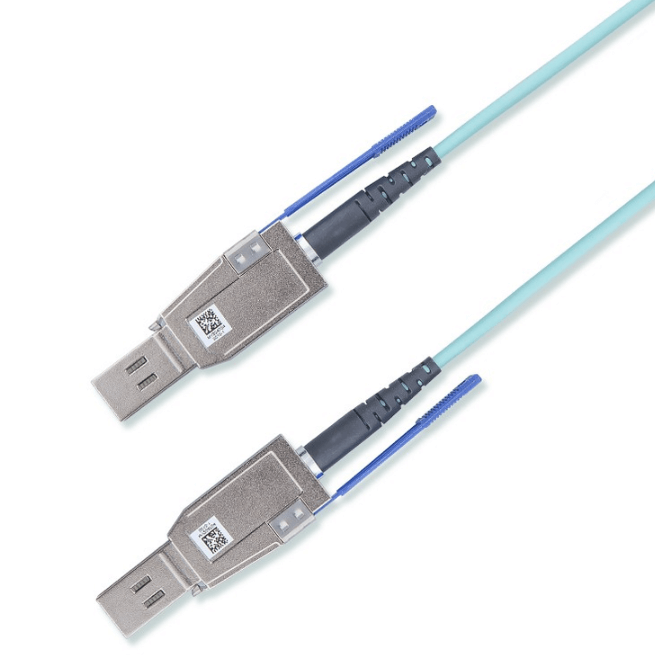
HD MiniSAS active optical cables play an important role in high-performance storage networks by enabling high-bandwidth SAS connectivity over distances that exceed the practical limits of copper cabling. By combining optical signal transmission with standard SFF-8644 HD MiniSAS interfaces, these cables support scalable, low-error storage interconnects in enterprise and cloud data center environments where signal integrity and reach are critical.
Extending SAS Connectivity Beyond Copper Limits
Traditional copper-based HD MiniSAS cables are constrained by attenuation, crosstalk, and electromagnetic interference as distance increases. In dense data centers or large storage deployments, these limitations can restrict system layout and rack placement.
HD MiniSAS active optical cables overcome these challenges by converting electrical signals into optical signals within the cable assembly. Optical transmission allows reliable SAS communication over significantly longer distances without the degradation typically associated with copper, making these cables suitable for rack-to-rack and row-level storage connections.
Supporting High-Bandwidth SAS Performance
HD MiniSAS AOCs are designed to support SAS 3.0 performance, delivering aggregate bandwidths up to 48 Gb per second depending on lane configuration. Optical transmission maintains consistent signal quality across all lanes, which is essential for storage workloads that require sustained throughput and predictable latency.
This performance consistency is especially important in environments running large RAID arrays, shared storage fabrics, or latency-sensitive applications where retransmissions and link instability are unacceptable.
Improving Signal Integrity and EMI Immunity
One of the key advantages of active optical SAS cabling is immunity to electromagnetic interference. Because data is transmitted as light rather than electrical current, HD MiniSAS AOCs are unaffected by EMI generated by power distribution units, cooling equipment, or neighboring network cabling.
This characteristic reduces bit error rates and improves overall link stability, particularly in equipment-dense data centers where electrical noise is difficult to control.
Maintaining Compatibility with Existing SAS Infrastructure
HD MiniSAS active optical cables use standard SFF-8644 external connectors, allowing them to integrate directly with existing SAS controllers, storage arrays, and expansion shelves.
This compatibility enables organizations to extend link distances or redesign physical layouts without replacing controllers or backplanes. The cable handles the optical conversion internally, so from the system perspective, it behaves like a standard SAS interconnect.
Enabling Flexible Data Center Layouts
In modern data centers, physical flexibility is increasingly important. HD MiniSAS AOCs support this by allowing storage resources to be distributed across racks or rows without compromising performance.
Their lighter weight and smaller bend radius compared to some copper assemblies also simplify cable management, reduce strain on connectors, and help preserve airflow within densely packed equipment racks.
Typical Deployment Scenarios
HD MiniSAS active optical cables are commonly deployed in:
-
Enterprise storage arrays with external expansion shelves
-
Cloud data centers requiring long-reach SAS connectivity
-
High-availability storage architectures with physical separation between components
-
Environments where EMI or grounding concerns limit copper use
In these scenarios, AOCs provide a reliable alternative when copper cabling becomes a bottleneck.
Installation and Handling Considerations
While HD MiniSAS AOCs simplify long-distance connectivity, they require careful handling. Optical components are more sensitive to excessive bending, crushing, or improper insertion than passive copper cables.
Installers should observe manufacturer bend radius guidelines, ensure connectors are fully seated, and avoid unnecessary stress on the cable assembly. Verifying compatibility with the host system is also important, as active optical cables draw power from the host interface.
Role in the Future of Storage Networking
As storage systems continue to scale in both bandwidth and physical footprint, active optical SAS cabling is expected to see broader adoption. While newer protocols and fabrics are emerging, SAS remains widely deployed in enterprise storage, and optical interconnects extend its relevance in large-scale architectures.
HD MiniSAS active optical cables provide a practical bridge between established SAS ecosystems and the growing need for longer, cleaner, and more flexible storage connectivity.
FAQ (Frequently Asked Questions)
What is an HD MiniSAS active optical cable?
It is a SAS interconnect that uses optical transmission within the cable while maintaining standard SFF-8644 HD MiniSAS connectors.
What speeds do HD MiniSAS AOCs support?
They typically support SAS 3.0 performance with aggregate bandwidths up to 48 Gb per second, depending on configuration.
Where are HD MiniSAS active optical cables most commonly used?
They are used in enterprise storage systems, cloud data centers, and environments requiring long-reach, high-bandwidth SAS connections.
Why choose active optical SAS cables instead of copper?
They offer longer supported distances, reduced signal loss, and immunity to electromagnetic interference compared to copper cabling.